
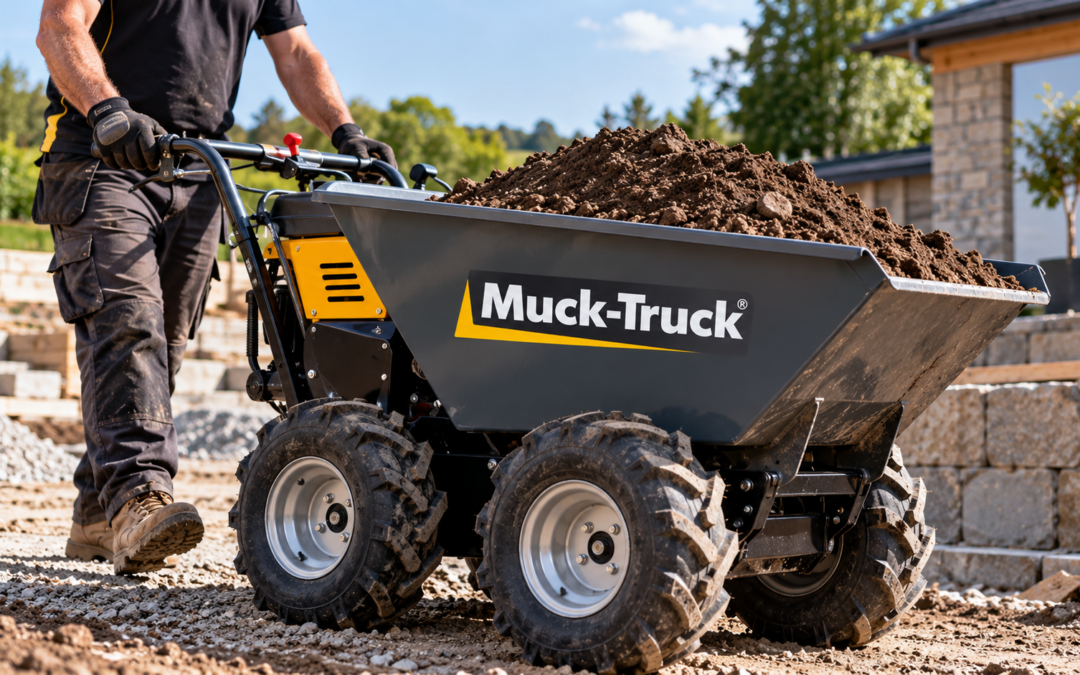
A Complete Guide to Motorised Wheelbarrows, Heavy-Duty Material Handling and Choosing the Right Machine
Moving heavy materials is one of the most physically demanding tasks in construction, landscaping, gardening and agriculture. Whether you’re transporting soil, gravel, building materials or garden waste, traditional wheelbarrows can require considerable physical effort, particularly when working on uneven ground or slopes.
A power barrow, also known as a powered wheelbarrow or motorised wheelbarrow, provides a practical alternative.
These compact machines use an engine or electric motor to help transport heavy loads, reducing the amount of manual pushing required and making material handling more efficient.
In this guide, we’ll explain how power barrows work, what they’re used for, their advantages over traditional wheelbarrows and what to consider when choosing the right model.
What Is a Power Barrow or Powered Wheelbarrow?
A power barrow is a motorised material-handling machine designed to transport heavy loads with less physical effort than a traditional wheelbarrow. It uses an engine or electric motor to drive the wheels or tracks, allowing the operator to move soil, rubble, gravel, timber and other materials across a worksite.
Unlike a conventional wheelbarrow, which relies entirely on human strength for movement, a power barrow provides powered assistance.
Most models feature a load-carrying skip or bucket, handlebars, drive controls and a tipping mechanism for unloading materials.
Power barrows are commonly used by builders, landscapers, gardeners, farmers and property maintenance professionals.
At Muck-Truck UK and Muck-Truck USA, you’ll find a range of compact powered wheelbarrows designed to make transporting materials easier across different working environments.
How Does a Powered Wheelbarrow Work?
A powered wheelbarrow works by transferring power from a petrol engine, gasoline engine or electric motor to a drive system that moves the machine forwards or backwards.
The operator controls the movement using handles, levers or other controls, depending on the model.
The process generally involves five stages:
-
Power generation: An engine or electric motor provides the energy required to move the machine.
-
Drive engagement: The operator activates the drive mechanism, transferring power to the wheels or tracks.
-
Load transportation: The machine moves materials across the ground with reduced manual pushing.
-
Speed and direction control: The operator controls movement according to the terrain, load and available space.
-
Unloading: Materials are emptied using a manual or powered tipping mechanism, depending on the model.
Many powered wheelbarrows are designed with a compact footprint, making them particularly useful where larger dumpers or material-handling equipment cannot easily operate.
What Is a Power Barrow Used For?
Power barrows are versatile machines used across a wide range of industries.
Construction and Building Work
Construction sites frequently require materials to be moved between delivery areas, storage locations and active work zones.
Power barrows can transport sand, aggregates, bricks, rubble and other building materials, reducing the physical effort involved in repeated journeys.
Their compact dimensions make them useful for residential building projects, extensions, renovations and restricted-access worksites.
For contractors working in confined areas, a powered wheelbarrow can offer a practical alternative to larger site dumpers.
Landscaping and Garden Maintenance
Landscapers regularly transport heavy or bulky materials, including topsoil, compost, mulch, turf and decorative stone.
A motorised wheelbarrow can make these tasks easier, particularly when working across large gardens, uneven ground or sloping landscapes.
Power barrows can also help move waste materials away from the working area, supporting a more organised and efficient landscaping project.
Agriculture and Farming
Agricultural work often involves transporting feed, manure, bedding, fencing materials and other supplies.
Powered wheelbarrows can help farmers and smallholders move these loads around yards, fields and outbuildings.
Compact models are especially useful where larger agricultural vehicles would be impractical.
Property Maintenance and Groundskeeping
Schools, estates, parks, golf courses and commercial properties frequently require ongoing grounds maintenance.
Power barrows can assist with transporting plants, soil, tools, equipment and green waste.
Their versatility makes them useful for both routine maintenance and larger seasonal projects.
What Are the Benefits of a Power Barrow Compared With a Traditional Wheelbarrow?
The main advantage of a power barrow is its ability to transport heavier loads with considerably less physical effort.
| Feature | Traditional wheelbarrow | Powered wheelbarrow |
|---|---|---|
| Movement | Manually pushed | Motor-assisted |
| Load capacity | Typically smaller | Up to 365kg on selected Muck-Truck models |
| Slopes | Requires significant effort | Powered traction assists movement |
| Uneven ground | Can be difficult to manoeuvre | Four-wheel-drive options available |
| Operator fatigue | Greater physical effort | Reduced pushing and lifting effort |
| Unloading | Usually manual tipping | Manual, hydraulic or electric tipping options |
Reduced Physical Strain
Repeatedly pushing heavy wheelbarrows can place considerable strain on the back, shoulders and arms.
A powered wheelbarrow reduces the effort required to move materials, particularly over longer distances or challenging terrain.
Although operators must still follow safe handling practices, motorised equipment can help reduce some of the physical demands associated with manual material transportation.
Increased Productivity
Moving larger loads in fewer journeys can help workers complete tasks more efficiently.
For example, the original Muck-Truck power barrow can carry up to 250kg, while the Max-Truck offers a carrying capacity of up to 365kg.
Both machines feature four-wheel drive, making them suitable for transporting materials over varied ground conditions.
Improved Traction on Difficult Terrain
Construction sites, farms and landscaping projects rarely provide perfectly smooth surfaces.
Four-wheel-drive power barrows can help operators move materials across wet, uneven or sloping ground where traditional wheelbarrows may be difficult to control.
However, operators must always follow the manufacturer’s guidance on gradients, stability and safe loading.
Petrol vs Electric Powered Wheelbarrows: Which Is Better?
One of the most important decisions when choosing a powered wheelbarrow is whether to select a petrol-powered or electric model.
Petrol-Powered Wheelbarrows
Petrol-powered wheelbarrows are popular for outdoor construction, landscaping and agricultural applications.
They generally offer convenient refuelling and are well suited to demanding work where access to charging facilities may be limited.
The Muck-Truck Max-Truck features a Honda GXV 160 engine, four-wheel drive and a 365kg carrying capacity.
Petrol models are particularly useful for outdoor work requiring extended operation, although they produce exhaust emissions and require regular engine maintenance.
Electric Powered Wheelbarrows
Electric powered wheelbarrows use rechargeable batteries rather than petrol engines.
They offer several advantages, including no exhaust emissions at the point of use, reduced engine maintenance and generally quieter operation.
The Muck-Truck Max EGO combines a 56V electric power system with a 365kg carrying capacity.
For applications requiring assisted unloading, the Power Barrow 4WD II offers four-wheel drive and electrically operated tipping, helping reduce the effort involved in emptying heavy loads.
Electric models are particularly attractive for residential environments, noise-sensitive locations and sites where exhaust emissions need to be minimised.
Battery runtime, charging arrangements and suitability for the working environment should always be considered.
What Should You Look for When Buying a Powered Wheelbarrow?
Choosing the right power barrow depends on the type of work being undertaken and the conditions in which the machine will operate.
1. Load Capacity
Consider the weight and volume of the materials you regularly transport.
A smaller machine may be suitable for domestic gardening, while commercial construction work could benefit from a higher-capacity model.
2. Width and Access
Check whether the machine can pass through garden gates, doorways and narrow pathways.
Compact dimensions are particularly important for landscaping contractors and residential construction projects.
3. Ground Conditions
Four-wheel-drive machines can provide useful traction on uneven ground.
For particularly demanding surfaces, assess the machine’s tyres, ground clearance and manufacturer-approved operating limits.
4. Tipping Mechanism
Manual tipping may be suitable for lighter or occasional loads.
Hydraulic or electric tipping can make unloading easier when regularly transporting heavy materials.
5. Accessories and Attachments
Additional attachments can increase the versatility of a powered wheelbarrow.
Muck-Truck offers a range of accessories, including flatbeds, skip extensions, towing attachments and snow ploughs.
These allow compatible machines to be adapted for different tasks without purchasing separate specialist equipment.
Are Powered Wheelbarrows Worth Buying?
For businesses and individuals who regularly move heavy materials, a powered wheelbarrow can be a worthwhile investment.
The potential benefits include reduced manual effort, fewer journeys, improved productivity and greater flexibility when working in restricted spaces.
The value of the investment depends on how frequently the machine will be used, the materials being transported and the cost of alternative equipment or manual labour.
For contractors, landscapers and grounds maintenance teams, a reliable power barrow can become an important part of everyday operations.
Frequently Asked Questions About Power Barrows
How much weight can a powered wheelbarrow carry?
Carrying capacity depends on the model. The original Muck-Truck carries up to 250kg (550lb), while selected larger models can transport up to 365kg (800lb).
Can a power barrow be used on slopes?
Yes. Many powered wheelbarrows are designed to operate on suitable slopes and uneven ground. However, safe gradient limits vary by machine and must be followed carefully.
Are electric powered wheelbarrows powerful enough for construction?
Yes. Modern electric models can provide substantial carrying capacity and powered traction. The Muck-Truck Max EGO, for example, supports loads of up to 365kg.
What is the difference between a power barrow and a mini dumper?
A power barrow is generally a compact, pedestrian-operated machine designed for transporting materials. Mini dumpers include a broader range of machines, some with larger capacities, tracked drive systems or ride-on operation.
Find the Right Powered Wheelbarrow With Muck-Truck
Whether you’re transporting construction materials, maintaining agricultural land or completing a landscaping project, a powered wheelbarrow can make demanding jobs easier.
By combining motor-assisted movement with practical load capacities and compact dimensions, power barrows provide an efficient alternative to traditional manual wheelbarrows.
Muck-Truck offers a range of petrol and electric machines designed for professional and domestic applications.
Explore the available models and choose a machine that suits your working environment, material-handling requirements and preferred power source.
UK customers: Browse the Muck-Truck UK range of power barrows and motorised wheelbarrows.
USA customers: Explore Muck-Truck powered wheelbarrows for construction, landscaping and property maintenance.