
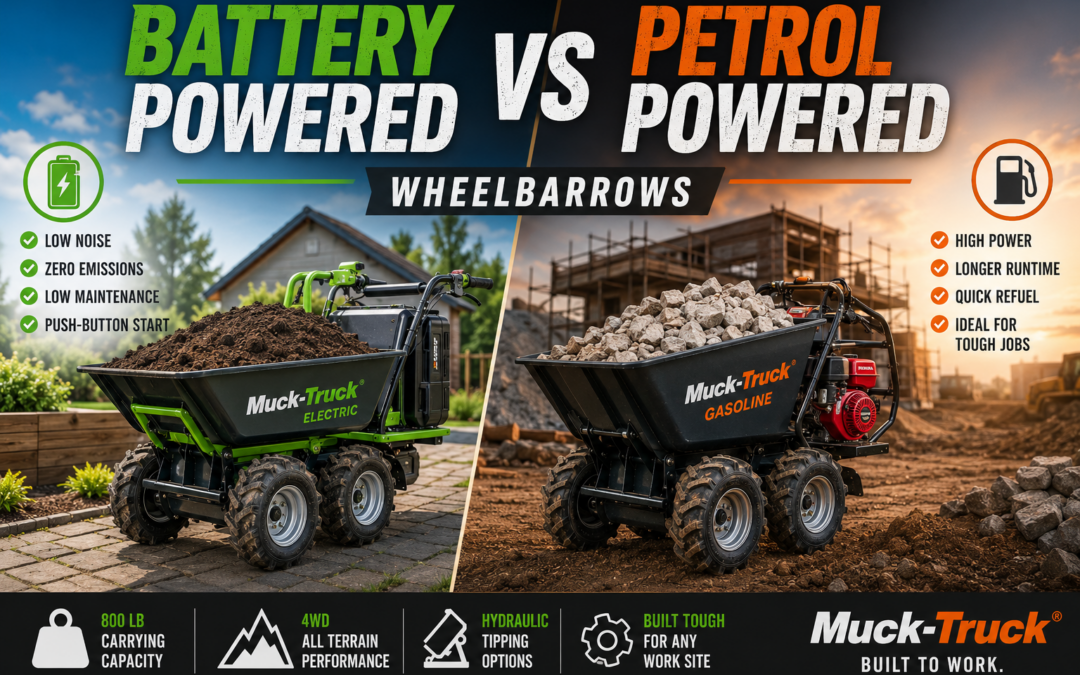
Battery Powered vs Petrol Powered Wheelbarrows: Which Is Right for Your Job?
Moving soil, gravel, concrete, mulch, debris and other heavy materials can be one of the most physically demanding parts of construction, landscaping and property maintenance. A powered wheelbarrow can make the job considerably easier, but choosing the right power source is an important decision.
Today, buyers have two main options: battery-powered wheelbarrows and petrol or gas-powered wheelbarrows.
Both provide significant advantages over a traditional wheelbarrow, but they suit different working environments and applications.
So, which is right for your job?
Battery Powered vs Petrol Powered Wheelbarrows: What Is the Difference?
A battery-powered wheelbarrow uses rechargeable batteries and an electric motor, offering quieter operation, no exhaust emissions at the point of use and reduced engine maintenance. A petrol-powered wheelbarrow uses an internal combustion engine, making it particularly suitable for demanding professional applications and longer working periods where quick refuelling is important.
The best choice depends on where you work, how frequently you use the machine, the loads you need to transport and whether you have convenient access to battery charging.
Muck-Truck offers both electric powered wheelbarrows and gasoline powered wheelbarrows, allowing operators to select a machine suited to their particular working environment.
What Is a Battery-Powered Wheelbarrow?
A battery-powered wheelbarrow replaces the conventional gasoline engine with an electric motor powered by rechargeable batteries.
The principle remains the same as other powered wheelbarrows. Rather than requiring the operator to provide the force needed to push a heavy load, the machine’s drive system does the hard work.
This can make transporting materials considerably easier, particularly when moving large quantities of soil, aggregate, garden waste, construction materials or equipment.
Muck-Truck’s electric range includes the EGO Max, Ladybug 2WD and Power Barrow 4WD II.
The EGO Max, for example, is based on the proven Max-Truck design but replaces the Honda engine with an EGO electric power unit. It provides an 8 cubic foot skip, an 800 lb carrying capacity and four-wheel drive.
What Is a Petrol or Gas-Powered Wheelbarrow?
A petrol-powered wheelbarrow, more commonly called a gas-powered wheelbarrow in the USA, uses a gasoline engine to power the machine’s drive system.
Gas-powered models have long been popular with construction professionals, landscapers, rental businesses and other commercial operators because they provide dependable performance for demanding material handling tasks.
The Muck-Truck gasoline range includes the original Muck-Truck®, Max-Truck™ and H-Max™.
The original Muck-Truck®, for example, can carry up to 550 lbs in its 6 cubic foot skip and is capable of climbing gradients of up to 30 degrees while fully loaded.
Performance: Battery vs Gas-Powered Wheelbarrows
One of the biggest questions when comparing battery and gasoline machines is performance.
Historically, gasoline machinery was often considered the automatic choice when maximum power was required. Modern battery technology has changed that considerably.
The EGO Max demonstrates how capable modern electric equipment has become. It offers the same 800 lb carrying capacity as the gasoline-powered Max-Truck and uses two quick-charging EGO lithium batteries.
For many construction, landscaping, garden maintenance and property management applications, this means choosing electric doesn’t necessarily mean sacrificing carrying capacity.
Gas-powered machines, however, continue to offer an important advantage for jobs where machinery needs to operate for extended periods. Once the fuel runs low, the machine can simply be refuelled and returned to work.
With an electric machine, working time needs to be considered alongside battery capacity, charging times and the availability of spare batteries.
Maintenance Requirements
Maintenance is another important difference between battery and gasoline powered wheelbarrows.
Battery-powered equipment generally has fewer engine-related maintenance requirements because there is no conventional gasoline engine.
There are no engine oil changes, spark plugs or fuel system maintenance associated with the electric motor itself.
Operators still need to maintain the rest of the machine correctly, including checking tires, controls, brakes, moving components and the general condition of the equipment.
Gasoline-powered machines require additional engine maintenance, but commercial-grade engines are designed specifically for demanding applications.
Muck-Truck’s gasoline-powered models use commercial Honda engines. The Max-Truck and H-Max, for example, use the Honda GXV 160 Commercial 5.5hp engine.
For contractors and businesses already operating gasoline-powered machinery, incorporating another gasoline machine into an existing maintenance routine may be relatively straightforward.
Running Costs
Running costs should be considered over the entire ownership period rather than simply looking at the initial purchase price.
A gas-powered wheelbarrow requires fuel throughout its working life as well as regular engine servicing and maintenance.
A battery-powered wheelbarrow requires electricity for charging and will eventually require battery replacement as batteries age.
Actual operating costs will depend heavily on how often the machine is used, local fuel and electricity costs, maintenance requirements and battery life.
For frequent users, the reduced routine engine maintenance associated with battery power can be attractive.
However, commercial operators should also consider whether additional batteries are required to keep the machine operating throughout the working day.
Noise and Working Environment
One of the clearest advantages of battery-powered machinery is reduced operating noise compared with gasoline engines.
This can be particularly valuable when working around residential properties, schools, hospitals, public spaces or other environments where excessive machinery noise may cause disruption.
Electric machines also produce no exhaust emissions at the point of use.
This can make battery-powered wheelbarrows particularly attractive for work around enclosed or partially enclosed environments, although operators must always follow appropriate workplace safety requirements.
Gasoline machines are naturally louder. The Max-Truck, for example, has a listed noise rating of up to 98 dB, meaning appropriate hearing protection and working practices should be considered.
Which Is Better for Construction?
For construction professionals, the decision largely depends on the type and duration of the work.
A gasoline-powered machine can be ideal for demanding jobs where equipment is expected to work for extended periods and easy refuelling is important.
The Max-Truck™ is particularly popular with rental shops, landscapers and builders and offers an 800 lb carrying capacity.
For jobs where unloading is another major consideration, the H-Max™ combines the same 800 lb class capacity with hydraulic tipping, helping operators empty the skip more easily and precisely.
However, electric models are increasingly capable alternatives for construction work.
The EGO Max provides the carrying capacity and four-wheel-drive capability needed for substantial loads while providing the advantages of battery power.
Which Is Better for Landscaping?
Landscapers can benefit from either power source.
For larger commercial landscaping projects involving long working days and repeated transportation of heavy materials, gasoline power remains an excellent option.
For residential landscaping, garden maintenance and jobs where reducing noise is particularly valuable, battery-powered equipment can be extremely attractive.
The Ladybug 2WD is designed specifically with large gardens and properties in mind, using battery power combined with a rear swivel wheel for easy steering.
Meanwhile, professionals requiring greater capacity can consider the EGO Max or Power Barrow 4WD II.
Battery-Powered Wheelbarrow Advantages
Battery-powered wheelbarrows can provide several important benefits:
- Quieter operation than gasoline-powered machines
- No exhaust emissions at the point of use
- Reduced engine maintenance
- Simple electric starting
- Suitable for residential and noise-sensitive environments
- No need to transport or store gasoline
- Strong performance from modern battery technology
For operators already using compatible battery-powered equipment, there may also be opportunities to incorporate the wheelbarrow into their existing battery and charging setup.
Gas-Powered Wheelbarrow Advantages
Gasoline-powered machines remain popular for good reason.
Their key advantages include:
- Proven technology for professional applications
- Quick and straightforward refuelling
- Suitable for extended working periods
- Commercial-grade engine options
- Excellent performance on demanding sites
- Well suited to construction and professional landscaping
- No dependency on battery charging infrastructure
For businesses operating machinery throughout the working day, the ability to refuel quickly can remain a significant advantage.
How to Choose Between Battery and Gas Power
Before buying a powered wheelbarrow, consider how the machine will actually be used.
Think about your working hours. If the machine will operate for extended periods every day, consider whether your battery setup can support the required runtime or whether quick gasoline refuelling would be more practical.
Consider the working environment. Battery power can be advantageous around homes, public areas and other noise-sensitive locations.
Look at carrying capacity. Don’t assume electric automatically means less capacity. The EGO Max, for example, offers an 800 lb carrying capacity.
Consider the terrain. If you’re regularly travelling over mud, gravel, uneven surfaces or inclines, traction is just as important as power source. Four-wheel-drive models can provide valuable additional capability.
Think about tipping. Moving the material is only half the job. Models offering hydraulic or electronic tipping can make unloading easier.
Calculate total ownership costs. Consider fuel or electricity, batteries, servicing, maintenance and expected usage rather than comparing purchase prices alone.
You can use Muck-Truck’s powered wheelbarrow comparison guide to compare capacities, dimensions, engines, drive systems and other specifications across the range.
Which Muck-Truck Powered Wheelbarrow Should You Choose?
For users wanting a proven gasoline-powered machine with compact dimensions, the original Muck-Truck® provides a 550 lb capacity and four-wheel-drive capability.
For heavier professional applications, the Max-Truck™ increases carrying capacity to 800 lbs.
The H-Max™ adds hydraulic tipping for operators who regularly need to empty heavy loads.
For buyers looking for battery power, the EGO Max combines an 800 lb capacity with two EGO lithium batteries and four-wheel drive.
The Ladybug 2WD provides a smaller electric option particularly suited to large gardens and properties, while the Power Barrow 4WD II combines electric power, four-wheel drive and electronic tipping.
Battery or Gas: Which Is Right for You?
There is no universal winner in the battery-powered vs petrol-powered wheelbarrow debate.
For professional contractors who prioritize long operating periods and rapid refuelling, a gasoline-powered wheelbarrow remains an excellent choice.
For landscapers, property owners and businesses looking for quieter operation, reduced engine maintenance and no exhaust emissions at the point of use, a battery-powered wheelbarrow can be the better solution.
Most importantly, don’t choose based on the power source alone. Consider carrying capacity, traction, tipping system, access requirements and how the machine will fit into your everyday workload.
Explore the complete Muck-Truck powered wheelbarrow range or compare Muck-Truck models to find the right machine for your next job.