
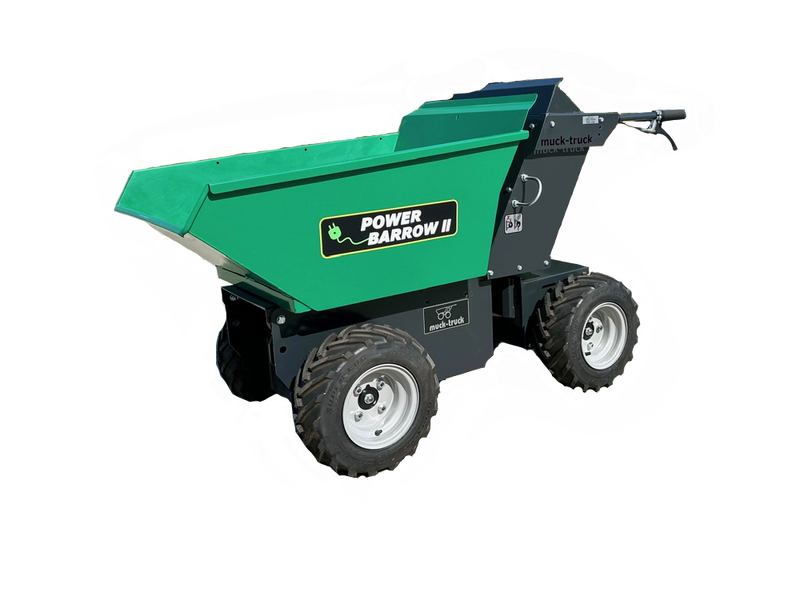
If you’ve ever tackled a demanding landscaping job, construction project, or large garden renovation, you’ll know how quickly a traditional wheelbarrow can become hard work. Heavy loads, uneven terrain, and repeated trips can slow progress and strain your body. That’s where a powered wheelbarrow comes in, a modern solution designed to make moving materials faster, safer, and far more efficient.
What Is a Powered Wheelbarrow?
A powered wheelbarrow, also known as a motorised wheelbarrow or micro dumper, is a compact machine designed to transport heavy materials with minimal physical effort. Unlike a traditional wheelbarrow, which relies entirely on manual pushing, a powered version uses an engine or electric motor to drive the wheels.
Machines like those from Muck Truck are built with professional performance in mind. They typically feature four-wheel drive, allowing them to move easily across uneven ground, mud, gravel, or slopes that would challenge a standard barrow.
Most powered wheelbarrows can carry significantly heavier loads than manual alternatives, often up to 250 kg or more, and some models can climb inclines of up to 30 degrees even when fully loaded.
In simple terms, a powered wheelbarrow combines the manoeuvrability of a traditional barrow with the strength and efficiency of a small dumper.
Key Features of a Powered Wheelbarrow
Powered wheelbarrows are designed to maximise productivity while reducing physical strain. Here are some of the standout features:
1. Engine or Battery Power
Most models are powered by either petrol engines (such as commercial-grade Honda engines) or modern electric battery systems.
Electric options are becoming increasingly popular for quieter, low-emission operation.
2. High Load Capacity
A powered wheelbarrow can typically carry two to three times more than a manual version, with capacities often ranging from 250 kg to 365 kg.
3. Four-Wheel Drive Traction
Unlike a single-wheel barrow, powered models often use four wheels for enhanced stability and grip, making them ideal for wet, uneven, or sloped terrain.
4. Compact Design
Despite their power, these machines are surprisingly compact, often narrow enough to fit through standard doorways and garden gates.
5. Easy Tipping Mechanisms
Some models include manual tipping, while others offer electric or hydraulic tipping at the push of a button, making unloading quick and effortless.
6. Versatile Attachments
Many powered wheelbarrows can be adapted with interchangeable attachments, allowing them to tow, carry flat loads, or even perform specialist tasks like clearing debris.
How Is It Different from a Traditional Wheelbarrow?
The biggest difference is simple: effort.
With a manual wheelbarrow, the operator must lift, balance, and push the load entirely on their own. This can be physically demanding, especially over long distances or challenging terrain.
A powered wheelbarrow, on the other hand, uses its motor to drive forward and carry the load. The operator simply guides it. This reduces fatigue, improves safety, and allows more work to be completed in less time.
In fact, powered models can dramatically increase productivity, some estimates suggest up to 3–4 times more efficient than manual alternatives.
When Should You Use a Powered Wheelbarrow?
A powered wheelbarrow is not always necessary, but in the right situations, it can be transformative. Here are some of the most common use cases:
1. Construction Projects
On building sites, moving materials like bricks, sand, concrete, or rubble is a constant task. Powered wheelbarrows streamline this process, especially when working alongside mini diggers or mixers.
2. Landscaping and Garden Design
For landscapers, transporting soil, turf, gravel, or paving slabs across uneven ground is much easier with a powered machine. The added traction and load capacity make a noticeable difference.
3. Working on Slopes or Rough Terrain
If your project involves hills, muddy areas, or uneven surfaces, a powered wheelbarrow provides the grip and stability needed to move safely and efficiently.
4. Large Domestic Projects
Homeowners undertaking major renovations, such as extensions, driveway installations, or large garden overhauls, can benefit greatly from hiring or purchasing a powered barrow.
5. Agricultural and Equestrian Use
Farmers and equestrian property owners often use powered wheelbarrows for moving feed, muck, or bedding. Their ability to handle heavy loads across fields and paddocks makes them invaluable.
6. Reducing Manual Labour and Injury Risk
Health and safety guidance increasingly encourages reducing manual handling where possible. Using a powered wheelbarrow helps minimise strain and the risk of workplace injuries.
Why Choose a Powered Wheelbarrow?
The main advantage is efficiency. Tasks that would take hours with a manual wheelbarrow can often be completed in a fraction of the time. This leads to:
- Faster project completion
- Reduced labour costs
- Less physical strain on workers
- Improved safety on-site
Additionally, machines like those from Muck Truck are designed for versatility, meaning one machine can handle multiple tasks simply by switching attachments.
Final Thoughts
A powered wheelbarrow is more than just a convenience, it’s a practical investment for anyone regularly moving heavy materials. Whether you’re a professional contractor, landscaper, or homeowner tackling a large project, it can significantly improve productivity while reducing effort and risk.
If your work involves frequent lifting, long distances, or challenging terrain, upgrading from a traditional wheelbarrow to a powered model isn’t just helpful, it can completely change the way you work.